Showing posts with label passiflora. Show all posts

Monday, December 17, 2012

Hybrids of Passiflora cearulea and loefgrenii

Flowers opened on two new plants on the balcony recently:

Passiflora 'Betty Myles Young' (P. caerulea 'Clear Sky' x P. loefgrenii)
Passiflora 'Betty Myles Young' bloom held in front of a vine
Passiflora 'Betty Myles Young'
P. 'Betty Myles Young' was created by using the tetraploid 'Clear Sky' as the female parent and P. loefgrenii as the male parent, while  Passiflora (loefgrenii x caerulea) was made using non-tetraploid (as far as I know) P. cearulea as the pollen parent and P. loefgrennii as the female parent at the Strybing Arboretum in Golden Gate Park.

Purple Passiflora hybrid flower
Passiflora (loefgrenii x caerulea)
The main differences I've noticed between the two plants are

  • 'Betty Myles Young' has larger leaves and flowers more vigorous vine in general
  • Flowers of loefgrenii x caerulea are slightly smaller, but darker and more evenly colored so far.
These differences are probably due to the increased chromosome count inherited from 'Clear Sky'.


Sunday, November 4, 2012

Passiflora x kewensis


I bought this under the name Passiflora 'Kew Gardens' and the first flower just opened today.

At first I thought is that it was labeled such because there was some uncertainty about its exact parentage, but appeared to the vendor to be  P. x kewensis or something similar. P. x kewensis is "considered to be P. caerulea x raddiana (kermesina)" According to John Vanderplank's Passionflowers.

pink and maroon passionflower bloom
Passiflora x kewensis

In Passiflora: Passionflowers of the World, Roland Fischer writes:

"Alas, many old hybrids are no longer under cultivation. In times of war, many private people have had to give up their collections, and even botanical gardens have had to cut back on costs incurred by overwintering plants in heated conservatories. A sad loss, for example, is the disappearance of Passiflora x kewensis (P. cearulea x kermesina, 1888), along with its parent plant P. kermesina. As soon as P. kermesina is reestablished in cultivation - and concerted efforts are being made to find it - Passiflora x kewensis can again be bred. In many collections, other crosses are cultivated erroneously under the name Passiflora x kewensis. A hybrid of P. racemosa is wide-spread under this name." 

Later in the same book, Torsten Ulmer confirms that this species had indeed be rediscovered in Brazil and re-entered cultivation. He goes on to state that Fischer had been using it for hybridization, but makes no mention of whether x kewensis had been recreated. 


Possible parents of my Passiflora 'Kew Gardens'

Purple and pink Passiflora kermesina flower
Passiflora kermesina - wikipedia.org
red-orange Passiflora racemosa flowers
P.racemosa - wikipedia.org


White and purple Passiflora caerulea flower
Passiflora caerulea - wikipedia.org
On my plant filaments are clear white and its balloon-like buds and thickly keeled sepals bear more than a passing resemblance to those of P. racemosa. 

Further research revealed the possibility that 'Kew Gardens' is not P. x kewensis, but rather P. racemosa x P. mucronata or P. galbana.


White Passiflora muconata flower
Passiflora mucronata -passiflora.co.uk

Passiflora mucronata has thickly-keeled sepals with awns - which matches my plant, and since my plant's flowers display almost no cearulea traits, I'm inclined to believe that this final option might be the case.

Whatever its parentage, it is lovely, and as a friend pointed out has "rainbow tendrils" (see the tendril above and to the right of the flower in my picture at the top of the post). I hope it makes it through the winter outdoors in San Francisco.

Sunday, October 28, 2012

Donna Brigham

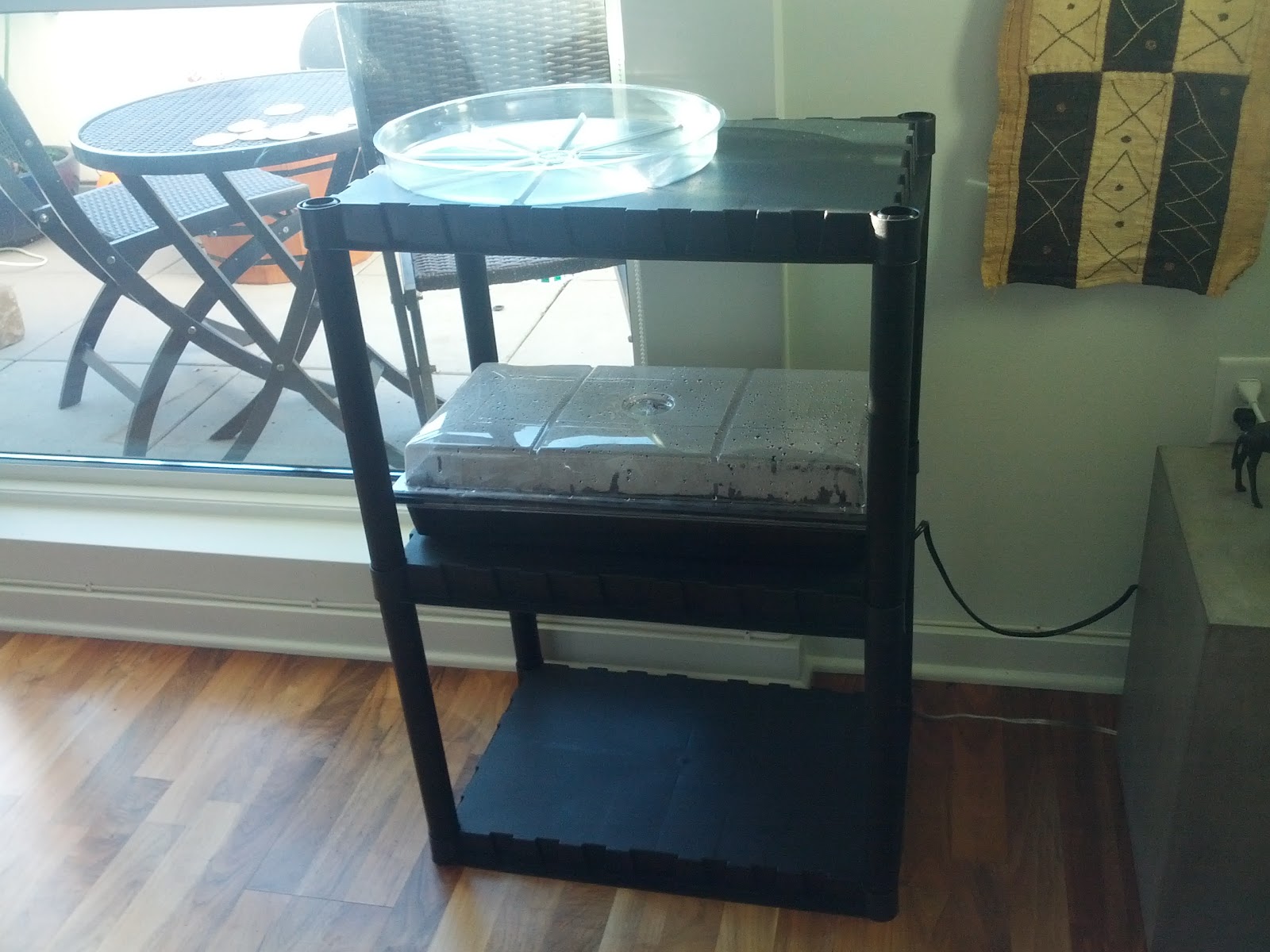
I went to Lowe's this afternoon to get an indoor shelf to put my passionflower seedlings and germination trays on and I noticed that there was a garden center across the street.
Plant rack with germination chamber

I picked up their last Passiflora 'Donna Brigham' and a Penstemon 'Bev Jensen' which I planted together in a terra cotta pot with a Lepchinia hastata that I'd purchased previously.


Passiflora 'Donna Brigham' with Penstemon and Lepechinia
I'd wanted a 'Donna Brigham' for quite a while: they had a sign for them at Sloat, but no actual plants the last few times I'd been there.

There are now 5 seedlings in the first (outside) germination chamber, here is a shot of 4 of them. The most recently sprouted was soaked in orange juice and planted on 10/2/2012 so germination in under a month!
4 Passiflora antioquiensis seedlings in a flat
Passiflora antioquiensis seedlings


More Tigers

The P. 'Purple Tiger' in my bedroom is blooming now. It's lighter colored than the plant that's outdoors.
Passiflora Purple Tiger
Passiflora 'Purple Tiger' Bud

Passiflora Purple Tiger
'Purple Tiger' flower from below
This plant shares a pot with P. phoenicia, P. alata 'Hirt's Ruby Glow', P. 'Flying V', P. candollei and P. vitifolia 'Scarlet Flame'.

I'm not certain that there is enough light and humidity in my room for all these plants: the batwing passionflowers have both lost growth tips, possibly because the air is too dry. 'Purple Tiger' is supposed to by a large and fast-growing clone, so I built a climbing structure up the wall, that I will extend across the ceiling if it ever comes to that.

Monday, October 22, 2012

Denver Botanic Garden

I visited the Denver Botanic Garden yesterday. It has a fantastic conservatory with one of the best rainforest displays of any garden I've ever visited (including Kew and the San Francisco Conservatory of Flowers).

There was also a bonsai collection, a Japanese tea garden, herb and prairie gardens, a scripture garden and an amphitheater. Unfortunately I only had my phone with me to take pictures.
a Passionflower with many purple filaments
Passiflora sp aff alata

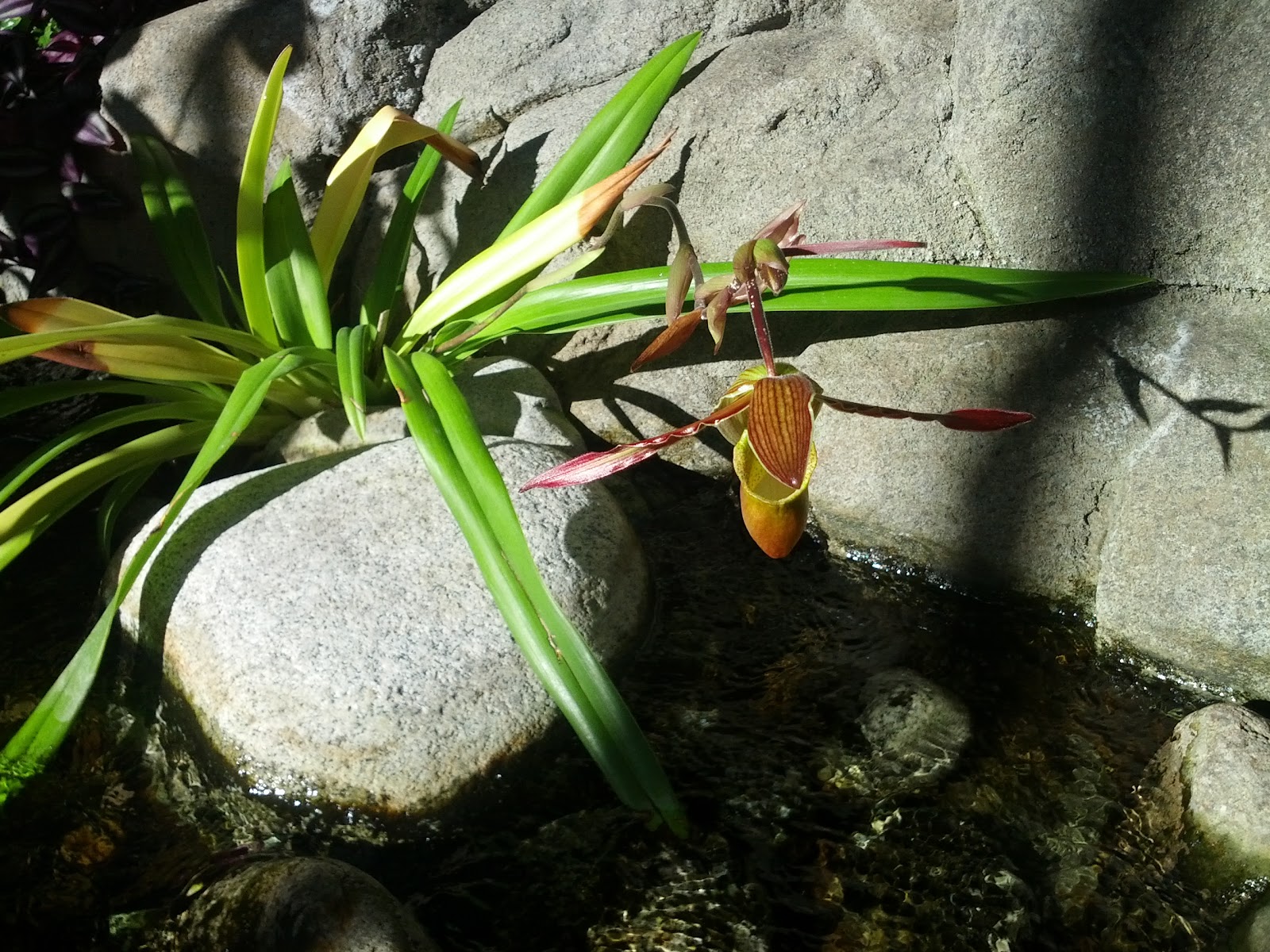
Red Phragmipedium orchid growing in a rocky nook
Phragmipedium Memoria Dick Clements 
Three purple Thunbergia vine flowers
Thunbergia grandiflora

Brown, purple and yellow Miltonia flowers
Some kind of Miltonia hybrid?

Green and maroon Canna indica leaves
Canna indica


Red and yellow pendant Heliconia flowers
Heliconia species

The vines, shrubs and trees growing inside the Boettcher Conservatory
Indoor Jungle

Brown and red Phragmipedium flowering in a stream inside the conservatory
Phragmipedium growing in a stream


Thursday, October 18, 2012

Passiflora 'Susan Brigham' a Tacsonia hybrid
Passiflora 'Susan Brigham'
This plant is on on the balcony next to my bedroom door. the first flower opened yesterday. I bought it under the ame 'Susan Brigham', which is listed by in Passiflora: Passionflowers of the world as P. tripartita var. mollissima x P. mixta.

This flower seems a bit bright and possibly a bit small to be the offspring of mollissima and mixta and it also has more developed filaments than either parent...perhaps there is P. insignis (which has brightly-colored, reflexted flowers with filaments) influence.

pink pendant Passiflora tripartita var mollissima flowers
Passiflora tripartita var. mollissima - from passiflora.it

Passiflora mixta - from wlu.ca


Passiflora insignis - from Yero Kuethe on flickr

To complicate things further, on the downstairs balcony I'd planted what I thought was a Passiflora 'Gloria Moreno' but the flowers are nearly identical to this alleged 'Susan Brigham'.
Passiflora x allardii - a hybrid of Passiflora caerulea and Passiflora quadrangularis
Passiflora x allardii
I bought two Passiflora x allardii vines (P. quadrangularis x P. cearulea 'Constance Elliot') today to grow along the wall on the downstairs balcony with a Jasminum polyanthum. The P. x allardii has beautiful flowers that are easier to admire than the P. x decaisneana 'Purple Tiger' since they are not so pendant. They also have a nice scent. However the Jasmine masks it with its much stronger perfume.

Today two female Anna's hummingbirds came to the balcony and one male. The females flew together and chattered as they fed. The male visited several times alone. His was very beautiful - stunning red/maroon gorget and dark green feathers.

I set up two lattice panels for the P. 'Mission Dolores' and P. parritae to climb from the downstairs balcony to the upstairs.

Tuesday, October 16, 2012

New Garden

Passiflora x decaisneana 'Purple Tiger' flower
Passiflora x decaisneana 'Purple Tiger'
I moved to a new apartment in San Francisco with a large balcony. I've planted a hummingbird garden and many passion flowers. One of the first passionflowers to bloom was a Passiflora x decaisneana 'Purple Tiger'.

P. x decaisneana is listed as P. alata x P. quadrangularis, two similar looking species with entire leaves and long purple and white filaments. This hybrid was first made in the 19th Century and was named for the botanist Joseph Decaisne. The flowers are fragrant and tend to hang down below the leaves


Hummingbirds visit the garden to feed everyday, and sometimes even stop to rest.


Thursday, April 1, 2010

Passiflora 'Mission Dolores'

'Mission Dolores' is the hybrid offspring of P. parritae and P. antioquiensis. The flowers are massive, and the vines vigorous (left). The red of P. antioquiensis is also incompletely dominant. If the hybrid is fertile, backcrossing might produce flowers in darker orange tones.

When I moved away from the house on 21st Street I took with me many many seeds, they all came from fruit on P. antioquiensis vines, and since the two species grew side by side in the yard, some of these seeds may be 'Mission Dolores'. When I have a yard of my own, I hope to find out!


Wednesday, March 31, 2010

My Introduction to Passiflora


From the end of July through the end of September 2009 I lived in a house on top of the hill between Noe Valley and Eureka Valley in San Francisco. It had an incredible view, and interestingly a climate quite similar to that of the Columbian highlands. Clouds, rain, mist and cool, breezy sunshine. My landlord's name was Carlos and he introduced me to passionflowers.

The front porch of his house was decorated with a massive Passiflora membranacea intermingled with purple Clematis and pink
roses. The backyard, however was where the true treasures were. He had one of the only, and probably one of the largest specimens of Passiflora parritae (left) in the United States. It completely engulfed a 20-foot Acer palmatum and scrambled up three stories of the house.

P. parritae is unique for several reasons. It has extremely large flowers (they can

be almost 8 inches across) of a very unusual salmon-orange color. They lack the distinctive corona, or wiry, fringe-like filame
nts found on many other passionflowers and have a very long floral tube. P. parritae takes this form because in the wild, they are pollinated by Ensifera ensifera, the sword-billed hummingb
ird (right).

Sadly, P. parritae is very rare, possibly even extinct in the wild. It was collected in a montane forest in Columbia and the only surviving clone was established in the San Francisco Botanical Garden in Strybing Arboretum. Cuttings from this plant seem to have made their way to some American collections, but they are all identical. This species appears to be be an obligate outcrosser, so unless another clone becomes available, all propagation must be vegetative.

Alternatively, hybrids can be made. And Carlos made many. He also had beautiful, enormous specimens of the wine-red Passiflora antioquiensis (right). This species, also from

Columbia is not quite as rare, but just as beautiful, and has the added benefit of producing many delicious yellow fruit. The cross pollination of P. antioquiensis and P. parritae produced the hybrid passionflower P. 'Mission Dolores'.

And what does that look like? Stay tuned!